

Chinese youth embrace new careers as AI boom reshapes job market
 0 Comment(s)
 Print
Print E-mail Xinhua, June 18, 2026
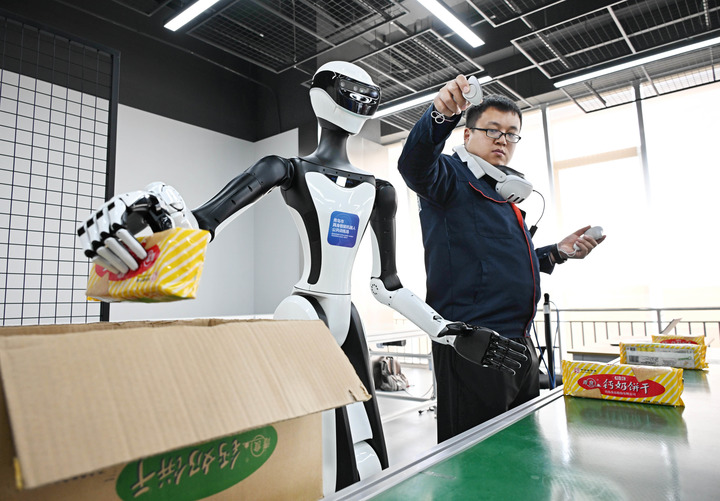
A trainer supervises the training of a humanoid robot in an assembly line scenario at a public training center for embodied AI in Qingdao, east China's Shandong Province, April 22, 2026. (Xinhua/Li Ziheng)
WUHAN, June 18 (Xinhua) -- Inside a bustling robot innovation center in Wuhan, capital of central China's Hubei Province, humanoid robots are learning to brew coffee, serve dishes and transport cargo. Beside the robots, young human trainers wearing VR headsets and holding motion controllers are fine-tuning every movement of the robots.
This emerging profession, officially titled "humanoid robot trainer," has been born from China's rapidly expanding artificial intelligence (AI) sector.
As AI reshapes traditional industries and fuels the growth of emerging sectors, it is opening up vast new employment opportunities for the country's young labor force.
Xu Mengfan, 23, has developed into a skilled humanoid robot trainer. Just two years ago, she was uncertain about her career prospects due to her academic background. Her career took a turn for the better after the Hubei humanoid robot innovation center was launched last year.
"I was very lucky," Xu said. "The center provided plenty of positions. We started with the most accessible trainer roles and became proficient in about three months."
She is not alone in making such a career shift. Also 23, Xu Shantao, a former software salesperson and milk tea shop owner, now works as a robot operation and maintenance engineer after self-studying mechanical repair and robotics.
"As long as you are willing to learn and take action, you can find opportunities to grow," said a representative from the innovation center. With more embodied AI companies joining the hub, there is a growing demand for specialized talent and operations personnel.
Beyond robotics, AI is generating new roles across various sectors.
In the Wuhan Optics Valley, an economically vibrant area home to over 800 AI enterprises, the booming AI-generated manju (comic-inspired short dramas) industry is driving demand for creative talent. Industry reports indicate that total views for these AI-produced comic dramas in China had exceeded 70 billion last year.
At a local AI manju production company, a 400-square-meter studio is packed with nearly 100 creators, which is an increase from just over 20 a year ago. To meet the surging demand, the company launched an online platform allowing creators nationwide, including college students and stay-at-home parents, to automatically generate comics and videos from scripts.
"You just click the mouse and the system generates everything from storyboards to the final video," said Liu Jing, the company's technical director. "With simple training, anyone can get started."
To support this growing workforce, local governments are fostering collaborative ecosystems. In the Wuhan Optics Valley, specialized startup communities offer office space and interest-free loans to AI entrepreneurs.
The results are evident in the data. Employment agencies report that AI-related job postings in Hubei have surged more than threefold this year.
Hubei's experience reflects a broader national trend. According to China's Ministry of Human Resources and Social Security, over 20 of the 72 new occupations identified in the past five years are directly tied to AI, with each expected to generate between 300,000 and 500,000 jobs in its early stages.
Policymakers are actively steering this transition. In August 2025, China issued guidelines for the "AI Plus" initiative, directing innovation resources toward sectors with strong employment potential. To prepare the workforce, China has made AI-integrated education a national priority, aiming to significantly scale up AI talent training by 2030.
"As AI technology continues to integrate more deeply with the real economy and policy support keeps growing, we will see a continuous emergence of new professions and employment models that align with industrial transformation, leading to a sustained optimization of the job market structure," said Zhang Chenggang, an expert with the Capital University of Economics and Business. ■
